

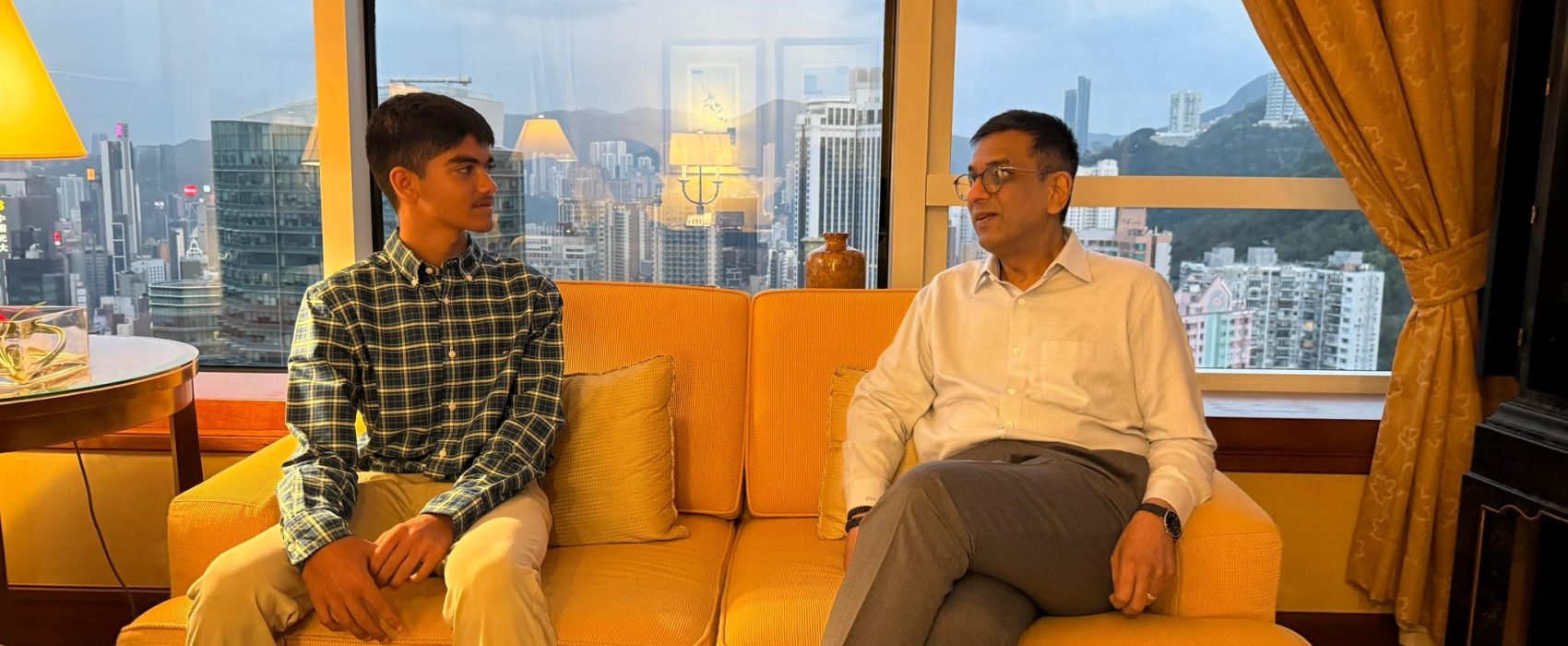
I was extremely fortunate to meet the Former Chief Justice of India, Justice Dr. Dhananjaya Yeshwant Chandrachud—an experience that left a lasting impression on me. As the 50th Chief Justice of India from November 2022 to November 2024, his work has shaped constitutional law and democratic values in profound ways.
Justice Chandrachud was in Hong Kong for an International Women’s Day event organized by the Forum of Indian Professionals in Hong Kong (FIPHK). I was hoping to attend the event but kids below 18 were not allowed due to high demand from the members. I was extremely disappointed as I always attend FIPHK Events that are relevant to me. FIPHK President Mr. Gautam Bardoloi got to know about my disappointment through my father. He has always encouraged me to attend such events, but he could not help in this case. I was both surprised and deeply honoured to be offered a one-on-one meeting with Justice Chandrachud.
Going into the meeting, I was quite frankly nervous. The Chief justice is one of the most important roles in India, and Chief Justice Chandrachud was one of the most influential Chief Justices of all time. He made significant contributions, such as:
Right to Privacy: He authored the majority opinion affirming the right to privacy as a fundamental right under Article 21, significantly reshaping constitutional rights.
Ayodhya Ram Janmabhoomi Title Dispute: He was part of the unanimous five-judge bench that resolved a decades-long dispute, bringing legal closure to an extremely sensitive issue.
Abrogation of Article 370: He led a Constitution Bench that upheld the constitutionality of the abrogation, addressing a matter of immense national importance.
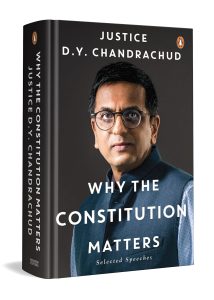 So, understandably, while waiting to meet him, I was unsure whether my questions were suitable and what he would think of them. I thought that such a big person would probably meet me for 5 minutes, sign his book (WHY THE CONSTITUTION MATTERS) that I was carrying, and take a photo or two. I was proven completely wrong.
Justice Chandrachud is one of the most down-to-earth, humble, and kind persons that I have ever met. Despite his having held such a significant role in the past and still being so influential, he was very approachable and took our conversation seriously. I was not a 15-year-old boy he had to fit into his schedule, but rather, he took the time to understand me and put me at ease. I felt a sense of positivity around his perspective right from the start and felt so encouraged by the faith he had in the future generations, our intelligence, our passion, and our commitment. Rather than rushing through the meeting, he listened carefully to each question, pausing thoughtfully before responding. That attentiveness made me feel heard and respected, despite my age.
He spent 30 minutes with me. He could have used that time to meet other influential business and legal leaders in Hong Kong. I learnt a lot in those 30 minutes, due to the honesty and openness with which Justice Chandrachud addressed my questions and the nuances he shared in his approach to topics and how they could be viewed.
I had heard him talk about radical speech and anti-terror laws, and I always wondered where the line was drawn. That day I understood the importance of caution and the value of liberty, the need for a law, and the responsibility not to misuse it for wrong ends. Last but not the least, I started thinking about the question: ‘Do Words = Bad Intent or Action’ and how one man’s personal radical words are weighed against the radical words of a person who is in a position of influence and how to build these nuances into the application of the law.
Life is full of challenges, which I have started to understand as a junior competitive tennis player. IB teaches us to be resilient in the face of challenges. I was curious to understand what was challenging for Justice Chandrachud in his career. I am deeply grateful for the honesty with which Justice Chandrachud responded to a 15-year-old. I learnt there was no universal right. I understood the need to balance what justice should look like with upholding the Constitution, while staying anchored in the role the judicial system plays in upholding it.
AI has touched all of us, and Justice Chandrachud contextualised how it would affect and change the way things are done. However, in the legal field, human intelligence and emotional quotient would still be needed to navigate contexts, moral issues, and grey areas.
I was so humbled to have learnt so much from someone who thought so deeply about doing right for society. To make India a better place. This meeting reinforced my desire to contribute meaningfully to society. Justice Chandrachud taught me that true leadership lies not in authority alone, but in humility, empathy, and an unwavering commitment to doing what is right.
Thank you, Justice Dr. D. Y. Chandrachud.
AI Chief Justice of India Constitution FIPHK India Justice Justice Chandrachud Law
Last modified: March 27, 2026